表面活性剂降压增注技术与提高石油采收率:跨学科视角的微观力学与宏观工程四部曲
Surfactant Pressure Reduction and Injection Enhancement Technology and Enhanced Oil Recovery: A Four-Part Series on Micromechanics and Macro-Engineering from a Multidisciplinary Perspective
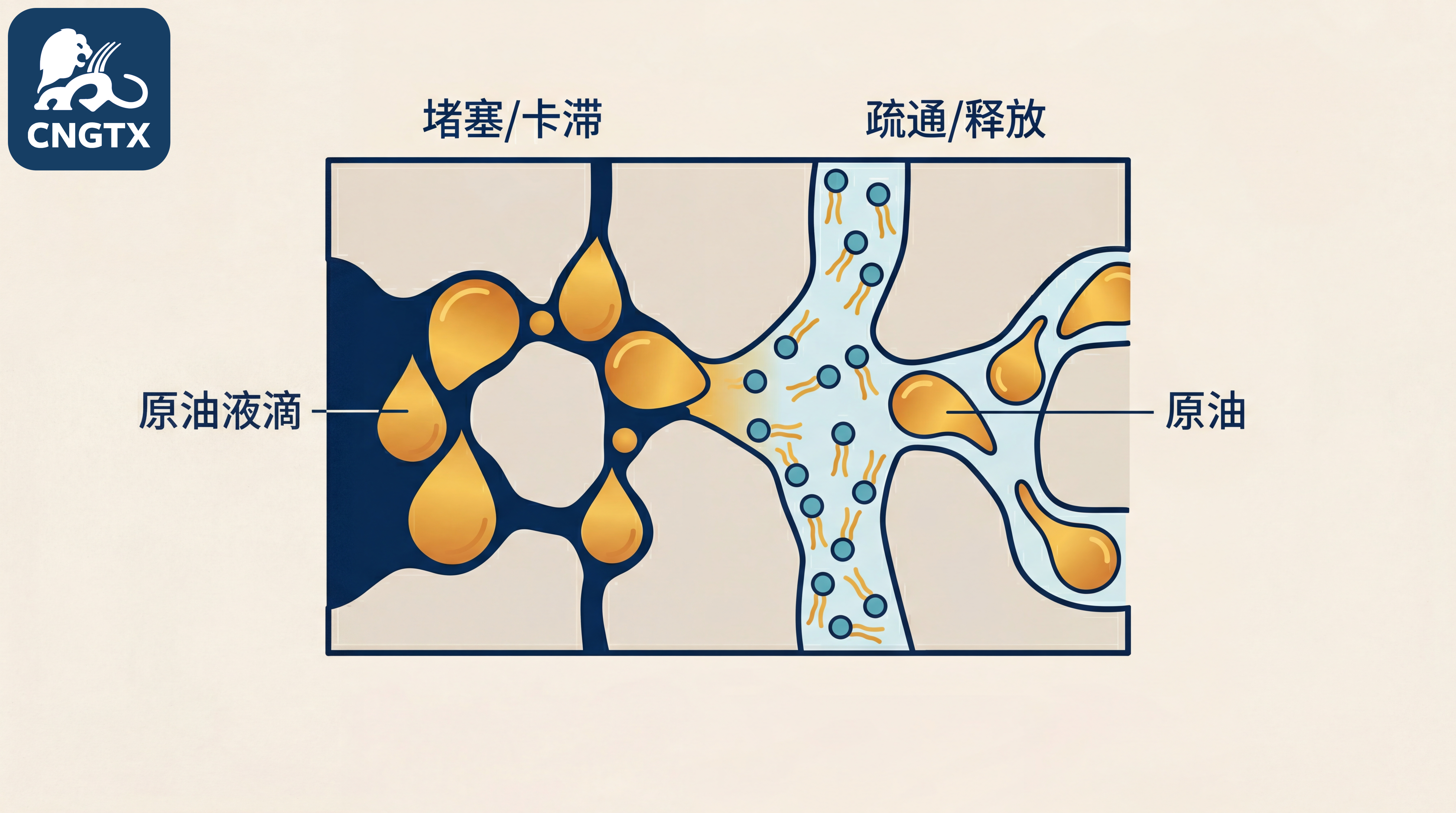
编者按:在全球能源转型与深层油藏开发并行的今天,表面活性剂降压增注技术正成为决定石油采收率能否实现质的飞跃的核心技术手段。本系列文章从流体力学、热力学、石油勘探与系统工程四大学科交汇处出发,以四部曲的形式全面拆解该技术的历史脉络、微观机理、现场工程方案与未来发展方向。
Editor's Note: In an era where global energy transition and deep reservoir development proceed hand in hand, surfactant pressure reduction and injection enhancement technology is becoming the core technique determining whether oil recovery rates can achieve a qualitative leap. This series departs from the intersection of fluid mechanics, thermodynamics, oil exploration, and system engineering, comprehensively deconstructing the technology's historical context, micro-mechanisms, field engineering solutions, and future directions in a four-part format.
第一部分:主旨与背景——表面活性剂降压增注技术与提高石油采收率的宏观历史与理论基础
Part 1: Introduction and Background — The Macro History and Theoretical Foundation of Surfactant Pressure Reduction and Injection Enhancement Technology and Enhanced Oil Recovery
欢迎来到我们关于表面活性剂降压增注技术(Surfactant pressure reduction and injection enhancement technology)与提高石油采收率(Enhanced Oil Recovery, EOR)的四部分系列文章的第一部分。从心理学(Psychology)的传播规律来看,将一个密集的科学主题分解成一个系列是使其更易于理解并吸引观众回流的绝佳方式,这不仅能够最大限度地提高读者参与度,还能有效降低受众在面对复杂油田化学(Oilfield Chemistry)概念时的认知负荷。在本系列中,我们将系统性地跨越流体力学(Fluid Mechanics)、热力学(Thermodynamics)、石油勘探(Oil Exploration)以及系统工程(System Engineering)的边界,为您全面拆解这项决定全球能源未来的核心技术。作为第一部分的开篇,我们将深入探讨该技术的核心定义、储层面临的物理矛盾以及其深厚的历史演变背景。
Welcome to the first part of our four-part series on Surfactant pressure reduction and injection enhancement technology and Enhanced Oil Recovery (EOR). From the communication principles of psychology, breaking a dense, scientific topic into a series is an excellent way to make it more approachable and keep audiences coming back for more; this not only maximizes reader engagement but also effectively reduces the audience's cognitive load when facing complex oilfield chemistry concepts. In this series, we will systematically cross the boundaries of fluid mechanics, thermodynamics, oil exploration, and system engineering to comprehensively deconstruct this core technology that dictates the future of global energy. As the opening of Part 1, we will delve into the core definition of the technology, the physical contradictions faced by reservoirs, and its profound historical evolutionary background.
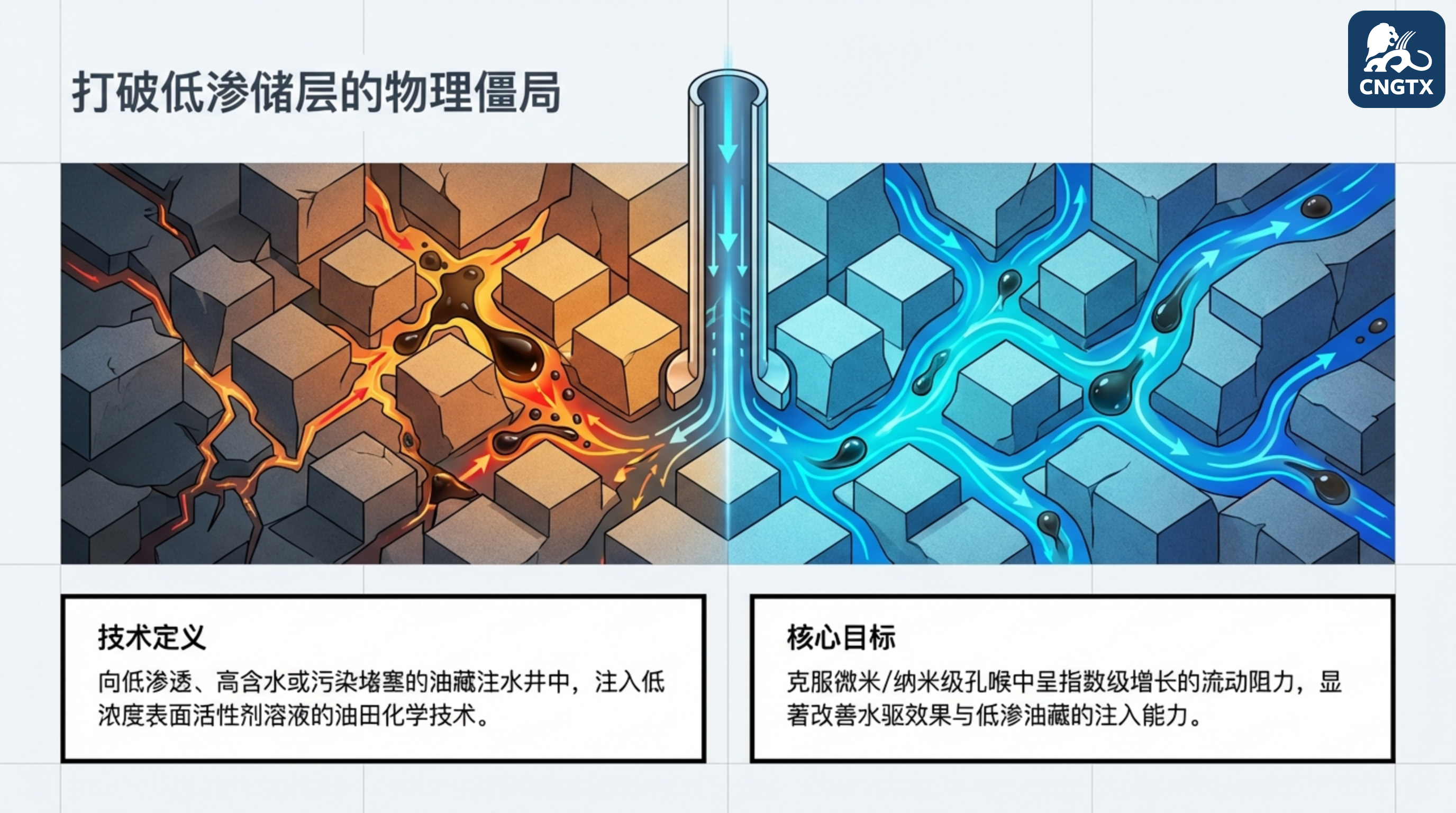
在现代石油勘探(Oil Exploration)与开发的生命周期中,随着易开采的高渗透油藏逐渐枯竭,全球能源行业的目光不可避免地转向了那些"难以啃下的骨头"——低渗透、特低渗透乃至致密油藏。这些地质结构的孔隙细小(通常为微米甚至纳米级)、喉道极其狭窄,流体在其中的流动阻力呈指数级增长。为了打破这一僵局,表面活性剂降压增注技术应运而生。表面活性剂降压增注技术是指将低浓度表面活性剂溶液注入低渗透、高含水或污染堵塞的油藏注水井中,通过降低油水界面张力、改变岩石润湿性、解除近井地带堵塞等作用,降低注水压力、提高注入能力、增加注水量,从而改善水驱效果、提高油田采收率的一项油田化学增产增注技术。
In the life cycle of modern oil exploration and development, as easily extractable high-permeability reservoirs gradually deplete, the global energy industry's focus has inevitably shifted to the "hard bones" — low permeability, ultra-low permeability, and even tight oil reservoirs. The pores of these geological structures are minuscule (typically micrometer or even nanometer scale), and the pore throats are extremely narrow, causing the fluid flow resistance within them to increase exponentially. To break this deadlock, Surfactant pressure reduction and injection enhancement technology emerged. This technology refers to an oilfield chemical stimulation technology wherein a low-concentration surfactant solution is injected into water injection wells of low-permeability, high-water-cut, or pollution-plugged reservoirs. By lowering the oil-water interfacial tension, altering rock wettability, and removing near-wellbore blockages, it reduces injection pressure, improves injection capacity, and increases water injection volume, thereby improving the waterflooding effect and enhancing oil recovery.
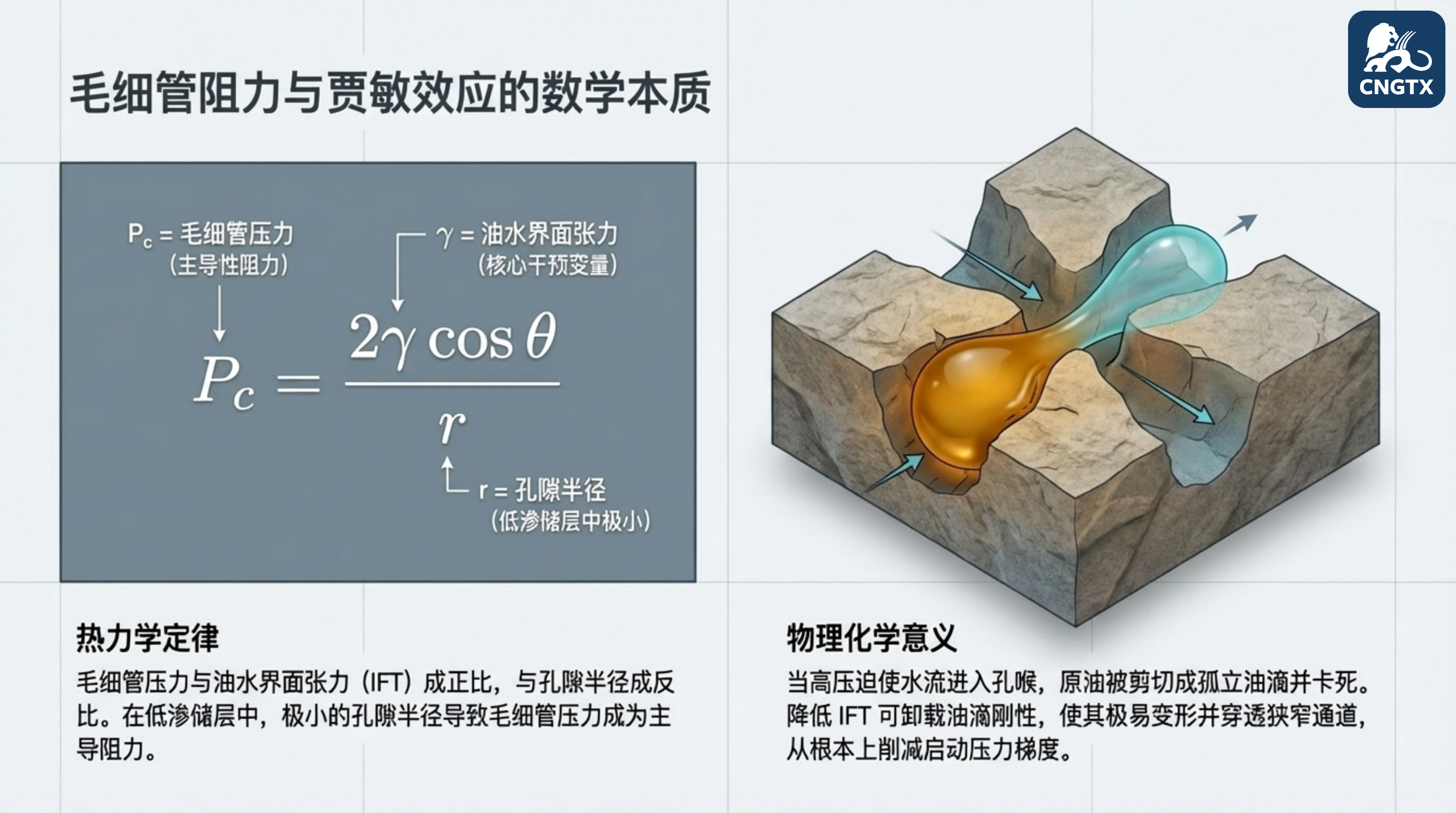
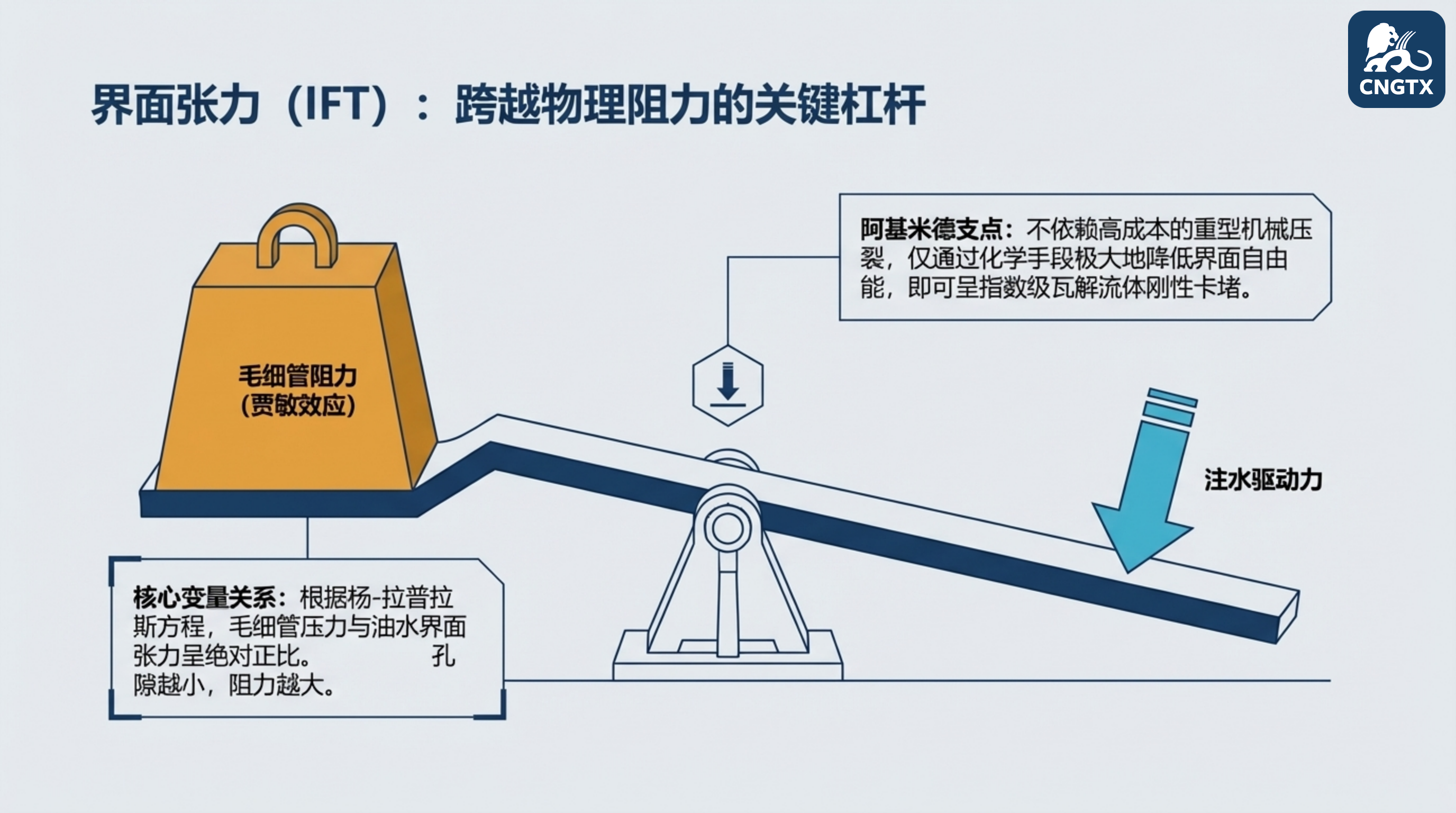
从热力学(Thermodynamics)和流体力学(Fluid Mechanics)的交叉视角来看,低渗透储层的核心矛盾在于毛细管阻力(Capillary Resistance)占据了主导地位。根据经典的杨-拉普拉斯方程(Young-Laplace Equation),毛细管压力与油水界面张力(Oil-water Interfacial Tension)成正比,与孔隙半径成反比。在低渗透岩芯中,极小的孔隙半径导致毛细管压力极大。当高压迫使水流进入孔喉时,原油被剪切成孤立的油滴,卡在狭窄的通道中,形成巨大的附加阻力,这在物理化学(Physiochemistry)中被称为贾敏效应(Jamin Effect)。通过引入具有"两亲性"分子结构的表面活性剂(Surfactants),工程界能够在不依赖重型机械压裂的前提下,利用化学手段"软化"这种流体物理阻力。
From the intersectional perspective of thermodynamics and fluid mechanics, the core contradiction in low-permeability reservoirs lies in the dominance of capillary resistance. According to the classical Young-Laplace Equation, capillary pressure is directly proportional to the oil-water interfacial tension and inversely proportional to the pore radius. In low-permeability cores, the extremely small pore radius results in an immensely high capillary pressure. When high pressure forces water into the pore throats, crude oil is sheared into isolated droplets that get stuck in the narrow channels, creating massive additional resistance, which is known in physiochemistry as the Jamin Effect. By introducing surfactants with an "amphiphilic" molecular structure, the engineering community can utilize chemical means to "soften" this fluid physical resistance without relying on heavy mechanical fracturing.
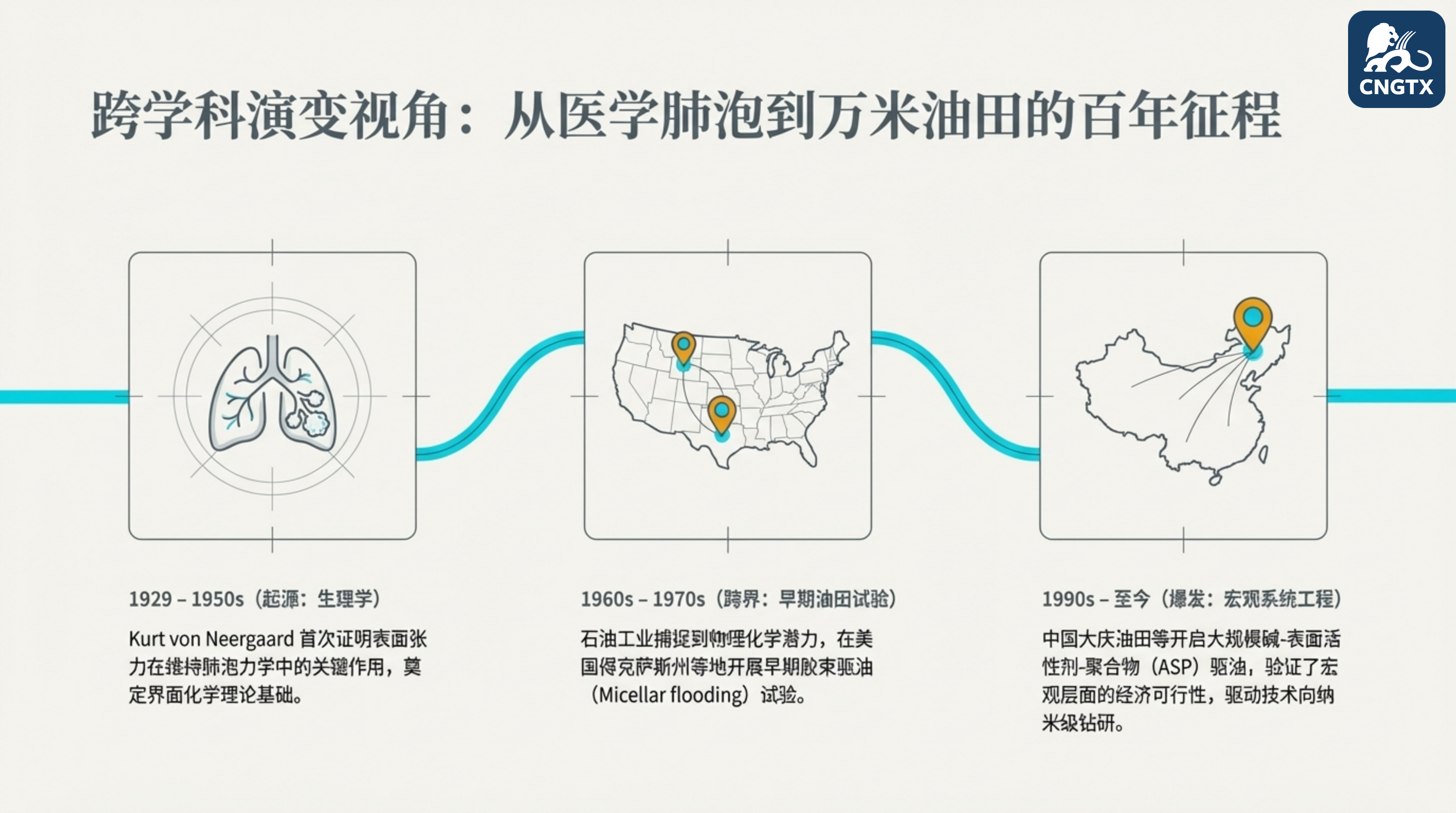
从历史角度来看,表面活性剂(Surfactants)的科学认知经历了一个多世纪的跨学科演变,这一历史证据为我们今天的工程应用奠定了无懈可击的理论基础。早在1929年,瑞士生理学家 Kurt von Neergaard 首次通过实验证明了表面张力在维持肺泡力学中的关键作用,这为后续的界面化学研究埋下了伏笔。进入20世纪50年代,科学家 Pattle、Clements 以及 Avery 和 Mead 进一步揭示了活性剂在降低边界层张力中的生理与物理学本质。到了20世纪60至70年代,石油工业敏锐地捕捉到了这一物理化学(Physiochemistry)原理的巨大潜力,开始尝试将其应用于提高石油采收率(Enhanced Oil Recovery)领域,并在德克萨斯州和怀俄明州等地开展了早期的胶束驱油(Micellar flooding)试验。
From a historical perspective, the scientific understanding of surfactants has undergone more than a century of multidisciplinary evolution, providing an unproblematic historical evidence base for our engineering applications today. As early as 1929, Swiss physiologist Kurt von Neergaard first demonstrated experimentally the crucial role of surface tension in maintaining alveolar mechanics, laying the groundwork for subsequent interfacial chemistry research. Entering the 1950s, scientists Pattle, Clements, as well as Avery and Mead further revealed the physiological and physical essence of surfactants in reducing boundary layer tension. By the 1960s and 1970s, the petroleum industry astutely grasped the immense potential of this physiochemistry principle and began attempting to apply it to the field of Enhanced Oil Recovery, conducting early micellar flooding trials in places like Texas and Wyoming.
历史的接力棒随后交给了中国的大型油田。自20世纪90年代起,大庆油田等基地的系统工程(System Engineering)团队开始大规模探索聚合物驱以及碱-表面活性剂-聚合物(ASP)驱油技术。长达数十年的矿场试验不仅证实了该技术在宏观层面的经济可行性,也促使全球油田化学界不断向下钻研至纳米级的微观机理。这种从医学界面的发现跨越到万米地下的原油开采的历史脉络,完美地诠释了跨学科研究如何重塑人类获取能源的方式。
The baton of history was subsequently passed to large-scale oilfields in China. Since the 1990s, system engineering teams at bases like the Daqing Oilfield began exploring polymer flooding and Alkaline-Surfactant-Polymer (ASP) flooding technologies on a massive scale. Decades of field trials not only confirmed the economic feasibility of this technology at the macro level but also drove the global oilfield chemistry community to continuously delve down to the micro-mechanisms at the nanoscale. This historical trajectory — spanning from medical interface discoveries to crude oil extraction thousands of meters underground — perfectly illustrates how multidisciplinary research reshapes the way humanity harvests energy.
既然我们已经通过第一部分确立了技术的历史锚点与宏观理论框架,在接下来的第二部分中,我们将把显微镜的焦距调至纳米级别。我们将深入探讨储层孔隙中发生的五大核心物理化学相互作用机理,并揭示在实验室中精确评估这些现象时所面临的终极测量学挑战。
Now that we have established the historical anchor and macro theoretical framework of the technology through Part 1, in the upcoming Part 2, we will adjust our microscope's focus to the nanometer level. We will delve deeply into the five core physicochemical interaction mechanisms occurring within reservoir pores and reveal the ultimate metrological challenges faced when accurately evaluating these phenomena in the laboratory.
第二部分:探究核心难题——界面张力、润湿性反转与超低界面张力测量的科学挑战
Part 2: Exploring Key Challenges — The Scientific Challenges of Interfacial Tension, Wettability Alteration, and Ultra-Low Interfacial Tension Measurement
承接我们在第一部分对储层宏观挑战与历史背景的概述,本部分将带领读者深入微观孔喉的世界。以多学科专家的视角,我们将深度剖析表面活性剂降压增注技术(Surfactant pressure reduction and injection enhancement technology)的具体作用机理。同时,我们也将揭开流体力学测量中一个被广泛误解的领域,明确展示如何克服超低界面张力(Ultra-low Interfacial Tension)测量的关键挑战。
Building upon our overview of macro reservoir challenges and historical background in Part 1, this section guides readers deep into the microscopic world of pore throats. From a multidisciplinary expert's perspective, we will deeply analyze the specific mechanisms of action of Surfactant pressure reduction and injection enhancement technology. Concurrently, we will unveil a widely misunderstood area in fluid mechanics measurement, clearly demonstrating how to overcome the critical challenge of measuring ultra-low interfacial tension.
降低油水界面张力,减小注水流动阻力
Lowering Oil-Water Interfacial Tension, Reducing Water Injection Flow Resistance
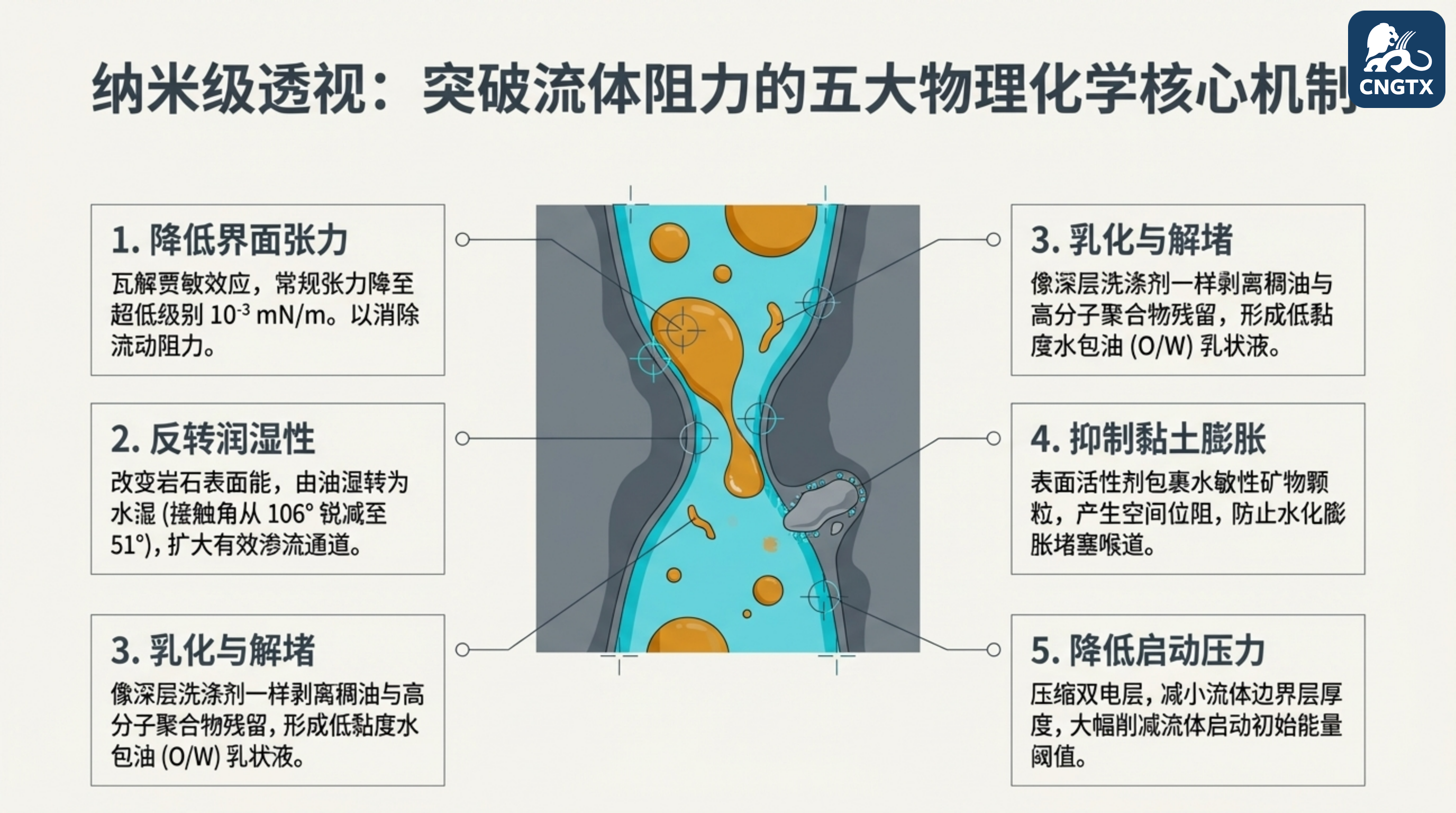
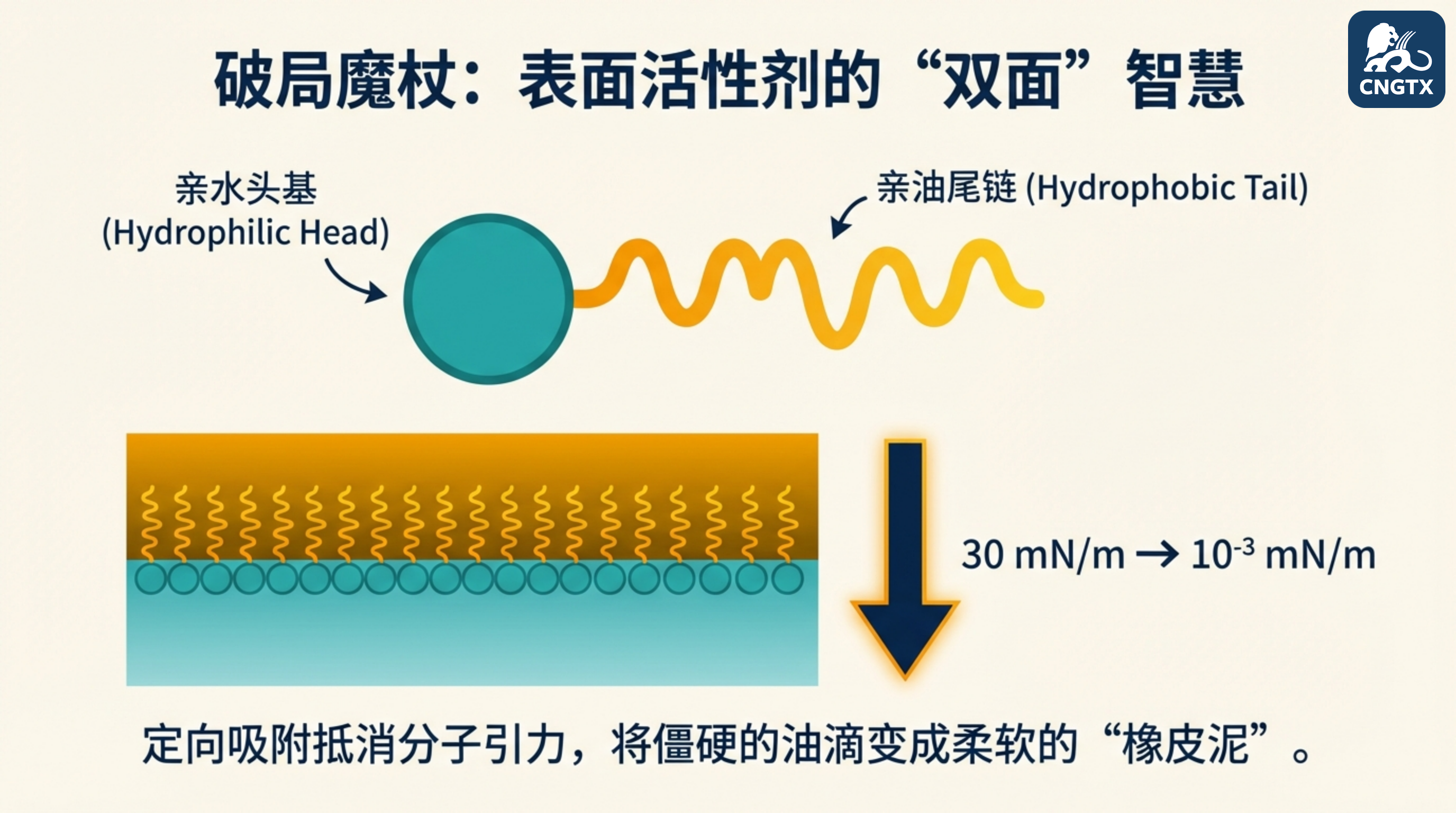
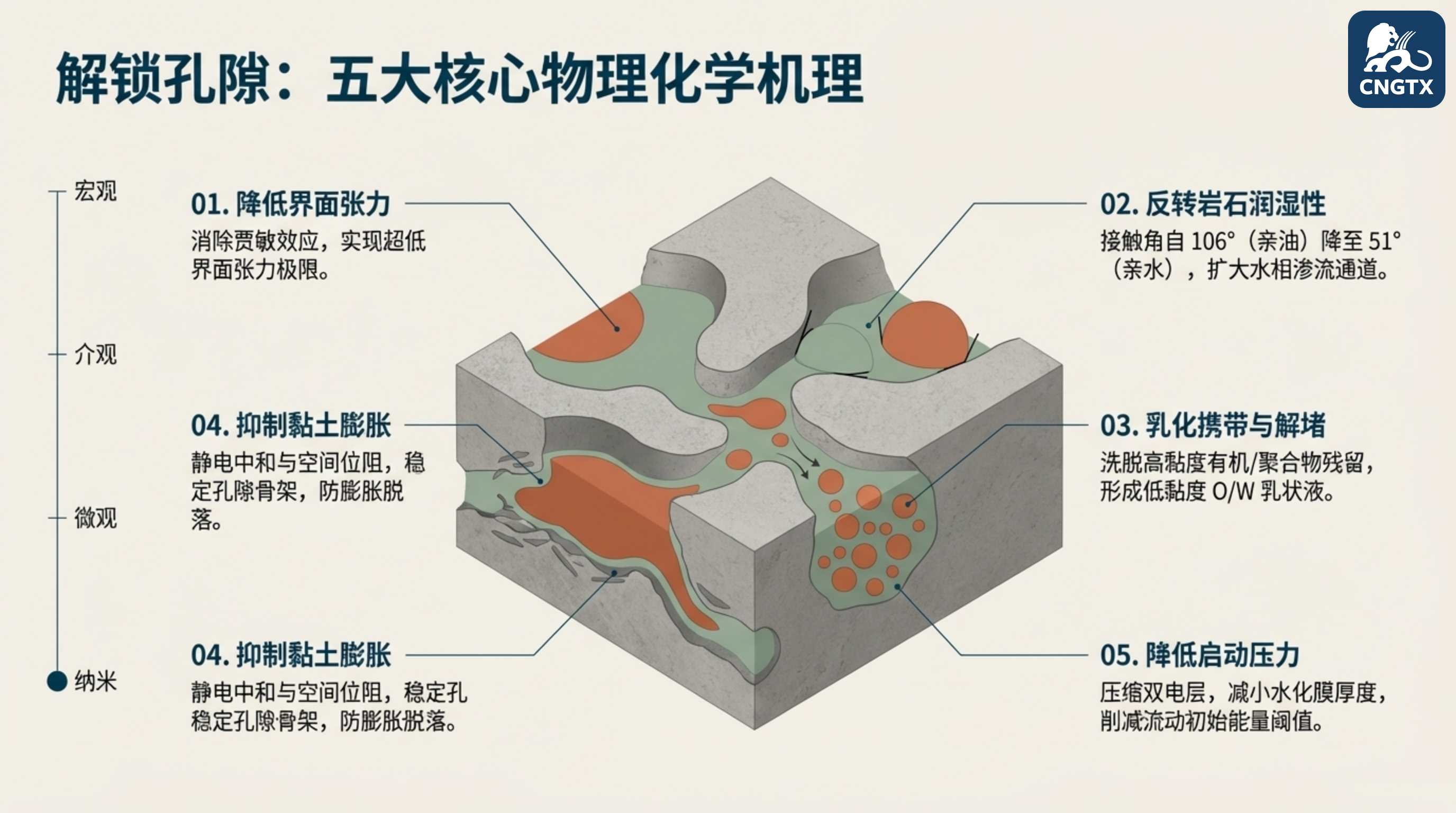
表面活性剂(Surfactants)体系能够在严苛的地质条件下实现显著的降压增注,主要依赖于五个精确协调的物理化学作用机理。首要的作用机理是降低油水界面张力,减小注水流动阻力。这是整个技术的核心基石。在低渗透储层中,油水流动产生的巨大阻力主要来源于毛细管力。特制的表面活性剂分子通过在油水界面高度定向吸附,能够将原本高达 30-40 mN/m 的常规界面张力断崖式地降至 10⁻¹ mN/m,甚至是超低级别的 10⁻³ mN/m。这种自由能的急剧下降彻底瓦解了贾敏效应(Jamin Effect),使油滴失去刚性,极易变形并穿过狭窄的微米级孔喉,从而消除了流动阻力。
The ability of surfactant systems to achieve significant pressure reduction and injection enhancement under harsh geological conditions relies primarily on five precisely coordinated physicochemical mechanisms. The foremost mechanism is lowering oil-water interfacial tension, reducing water injection flow resistance. This is the core cornerstone of the entire technology. In low-permeability reservoirs, the immense resistance generated by oil and water flow originates mainly from capillary force. Specialized surfactant molecules, through highly directional adsorption at the oil-water interface, can drastically reduce the conventional interfacial tension of 30–40 mN/m down to 10⁻¹ mN/m, or even the ultra-low level of 10⁻³ mN/m. This sharp drop in free energy thoroughly dismantles the Jamin Effect, causing oil droplets to lose their rigidity, easily deform, and pass through narrow micrometer-scale pore throats, thereby eliminating flow resistance.
反转岩石润湿性,扩大水相渗流通道
Reversing Rock Wettability, Expanding Water-Phase Seepage Channels
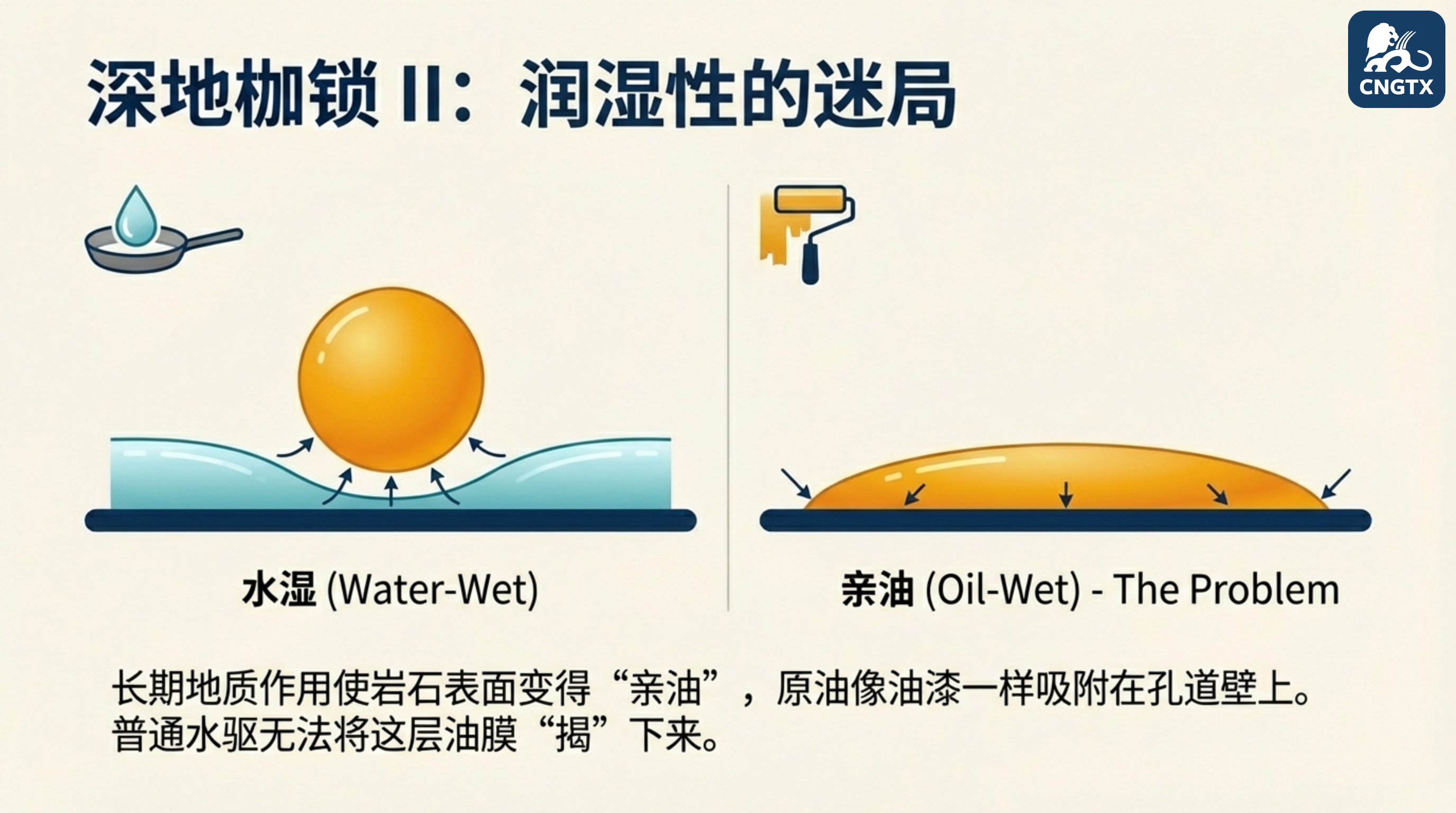
第二个关键机制涉及反转岩石润湿性,由油湿/中性湿向水湿转变,扩大水相渗流通道。大多数低渗透油藏的岩石表面倾向于亲油或弱亲油,这使得水相极难进入孔隙。注入的表面活性剂分子能够吸附在岩石矿物表面,改变其表面能。这种吸附作用有效地将岩石的"性格"反转为水湿(亲水)状态,导致水驱油时的接触角显著减小(例如从106°降低至51°)。润湿性反转后,注入水能够自发地沿着岩石表面铺展形成连续的水膜,这从根本上减少了水流与岩壁间的摩擦阻力,扩大了有效渗流通道。
The second critical mechanism involves reversing rock wettability, transitioning from oil-wet/neutral-wet to water-wet, expanding water-phase seepage channels. The rock surfaces of most low-permeability reservoirs tend to be oil-wet or weakly oil-wet, making it extremely difficult for the water phase to enter the pores. Injected surfactant molecules can adsorb onto the mineral surfaces of the rock, altering their surface energy. This adsorption effect effectively reverses the rock's "character" into a water-wet (hydrophilic) state, causing a significant reduction in the contact angle during waterflooding (e.g., decreasing from 106° to 51°). After wettability alteration, the injected water can spontaneously spread along the rock surface to form a continuous water film, which fundamentally reduces the frictional resistance between the water flow and the rock wall, expanding the effective seepage channels.
乳化携带油滴、解除有机堵塞,疏通近井渗流通道
Emulsifying and Carrying Oil Droplets, Removing Organic Blockages, Clearing Near-Wellbore Seepage Channels
第三项核心机制是乳化携带油滴、解除有机堵塞,疏通近井渗流通道。在长期的注水开发过程中,注水井近井地带的岩石表面往往会吸附一层厚重的稠油油膜或高分子聚合物残留。表面活性剂如同深层"洗涤剂",通过乳化作用将这些顽固的有机油膜剥离、分散,形成低黏度的水包油(O/W)乳状液。这种强效的洗油作用不仅清除了物理空间上的堵塞,恢复了地层的原始渗透率,还能将盲端孔隙中的残余油启动并随液流携带出地层。
The third core mechanism is emulsifying and carrying oil droplets, removing organic blockages, and clearing near-wellbore seepage channels. During long-term water injection development, the rock surfaces in the near-wellbore area of injection wells often adsorb a heavy crude oil film or high-molecular polymer residue. Surfactants act as deep "detergents," stripping and dispersing these stubborn organic oil films through emulsification to form low-viscosity oil-in-water (O/W) emulsions. This potent oil-washing action not only clears the blockage in physical space and restores the formation's original permeability but also mobilizes residual oil in dead-end pores and carries it out of the formation with the fluid flow.
抑制黏土矿物膨胀与运移,稳定地层孔隙结构
Inhibiting Clay Mineral Swelling and Migration, Stabilizing Formation Pore Structures
第四项不可忽视的机理是抑制黏土矿物膨胀与运移,稳定地层孔隙结构。许多储层中含有高比例的蒙脱石等水敏性黏土矿物。当外来淡水注入时,这些矿物极易发生水化膨胀,导致黏土微粒脱落并随流体运移,最终在狭窄喉道处形成致命的机械堵塞。特定的阳离子或双子(Gemini)表面活性剂能够通过静电中和与离子交换机制,紧密包裹在黏土颗粒表面,形成具有极强空间位阻的保护层。这有效阻止了水分子的侵入,起到长期防膨和稳定岩石骨架的作用,为复杂的储层环境提供了一种极其温和的化学保护。
The fourth non-negligible mechanism is inhibiting clay mineral swelling and migration, stabilizing formation pore structures. Many reservoirs contain a high proportion of water-sensitive clay minerals such as montmorillonite. When external fresh water is injected, these minerals are highly prone to hydration swelling, causing clay fines to detach and migrate with the fluid, ultimately forming fatal mechanical blockages at narrow throats. Specific cationic or Gemini surfactants can tightly encapsulate clay particle surfaces through electrostatic neutralization and ion exchange mechanisms, forming a protective layer with immense steric hindrance. This effectively prevents the intrusion of water molecules, serving the purpose of long-term anti-swelling and stabilization of the rock skeleton, providing an extremely mild chemical protection for complex reservoir environments.
降低毛管阻力,减小注水启动压力梯度
Reducing Capillary Resistance, Lowering the Water Injection Startup Pressure Gradient
第五个机理总结为降低毛管阻力,减小注水启动压力梯度。综合界面张力降低和润湿性反转的效果,流体在岩壁表面的双电层被压缩,水化膜厚度显著减小,从而有效降低了流体流动的边界层厚度。这从流体力学层面直接削减了流体启动所需的初始能量阈值,使得低渗孔隙中的流体在较低的外加驱动力下即可克服毛管阻力,实现稳定的渗流网络扩散。
The fifth mechanism is summarized as reducing capillary resistance, lowering the water injection startup pressure gradient. Integrating the effects of interfacial tension reduction and wettability alteration, the electrical double layer of the fluid on the rock wall surface is compressed, and the thickness of the hydration film is significantly reduced, thereby effectively decreasing the boundary layer thickness of fluid flow. This directly cuts down the initial energy threshold required for fluid startup from a fluid mechanics level, enabling fluids in low-permeability pores to overcome capillary resistance under lower external driving forces and achieve stable percolation network diffusion.
超低界面张力的测量挑战:旋转滴界面张力仪
The Measurement Challenge of Ultra-Low Interfacial Tension: The Spinning Drop Tensiometer
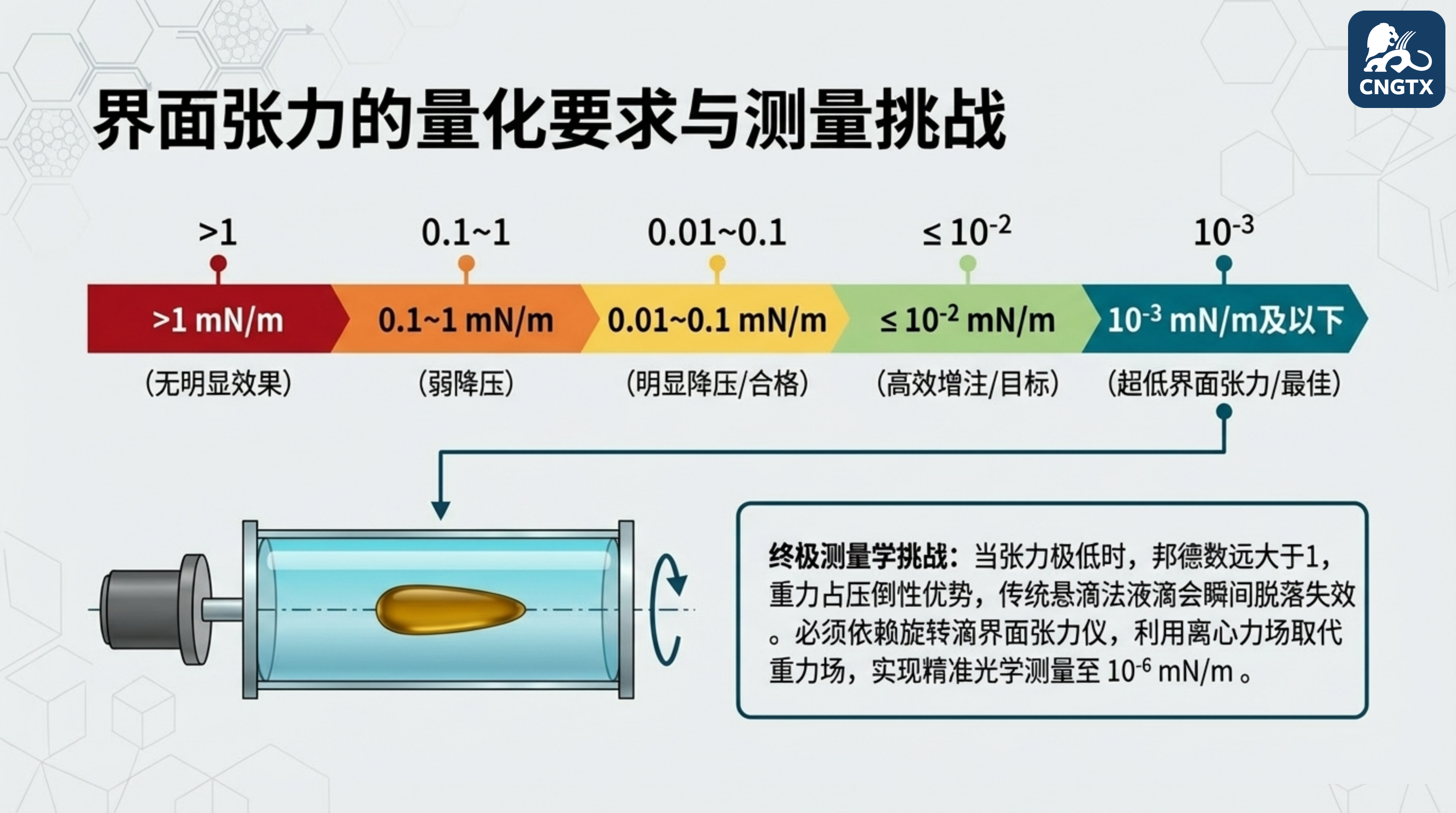
在理解了上述五大微观机理后,严谨的流体力学(Fluid Mechanics)和物理化学评估面临着一项巨大的挑战:如何精确测量决定技术成败的超低界面张力(10⁻³ mN/m)。在此必须声明一个至关重要的学术共识:超低界面张力的测量仅通过旋转滴界面张力仪来实现。在传统的悬滴法(Pendant Drop)测量中,仪器依赖于液滴的重力与表面张力之间的平衡来进行光学形状分析。然而,当表面活性剂将界面张力降至 1 mN/m 以下时,重力的影响将取得压倒性优势(即邦德数 Bo >> 1)。由于微弱的界面张力根本无法托住液滴的重量,油滴会瞬间从注射针尖脱落,导致悬滴法彻底失效。
After understanding the above five microscopic mechanisms, rigorous fluid mechanics and physiochemical evaluation face a colossal challenge: how to accurately measure the ultra-low interfacial tension (10⁻³ mN/m) that determines the technology's success. Here, a crucial academic consensus must be stated: measuring ultra-low interfacial tension is achieved solely with a spinning drop tensiometer. In traditional Pendant Drop measurement, the instrument relies on the balance between the droplet's gravity and surface tension to conduct optical shape analysis. However, when surfactants lower the interfacial tension below 1 mN/m, the influence of gravity gains an overwhelming advantage (i.e., Bond Number Bo >> 1). Because the weak interfacial tension simply cannot support the droplet's weight, the oil droplet will instantly detach from the injection needle tip, causing the pendant drop method to fail completely.
为了突破这一物理限制,旋转滴界面张力仪(Spinning Drop Tensiometer)应运而生。该设备巧妙地利用高速旋转的离心力场取代了重力场。在测量过程中,将装有高密度外相流体和低密度内相油滴的玻璃毛细管水平放置,并以高达 10,000 至 15,000 rpm 的转速旋转。在强大的离心力作用下,内部的油滴被沿中心轴拉长成圆柱形。当离心力使油滴向外扩张的趋势与界面张力使其收缩的趋势达到陀螺静力学平衡(Gyrostatic equilibrium)时,系统便能运用 Vonnegut 方程,通过光学测量液滴的直径或曲率,精确计算出低至 10⁻⁶ mN/m 的超低界面张力。这一测量学的突破,是验证所有增注体系效能的唯一科学基石。
To break through this physical limitation, the Spinning Drop Tensiometer came into being. This equipment ingeniously utilizes the centrifugal force field of high-speed rotation to replace the gravitational field. During measurement, a glass capillary containing a high-density outer continuous phase and a low-density inner oil droplet is placed horizontally and spun at speeds up to 10,000 to 15,000 rpm. Under the powerful centrifugal force, the internal oil droplet is elongated along the central axis into a cylindrical shape. When the centrifugal force's tendency to expand the oil droplet outward and the interfacial tension's tendency to contract it reach gyrostatic equilibrium, the system can utilize Vonnegut's equation to accurately calculate ultra-low interfacial tensions down to 10⁻⁶ mN/m by optically measuring the droplet's diameter or curvature. This metrological breakthrough is the sole scientific cornerstone for verifying the efficacy of all injection enhancement systems.
既然我们已经厘清了复杂的微观机理并解决了超低界面张力的核心测量难题,接下来的关键问题是:这些在实验室内表现完美的化学体系,如何在现实中极其复杂的储层条件下发挥作用?在第三部分中,我们将跨越从实验室到宏观油田的鸿沟,探讨现场应用的系统工程策略与解决方案。
Now that we have clarified the complex microscopic mechanisms and solved the core measurement conundrum of ultra-low interfacial tension, the next key question is: how do these chemical systems, which perform perfectly in the laboratory, function under extremely complex real-world reservoir conditions? In Part 3, we will bridge the gap from the laboratory to the macroscopic oilfield, exploring the system engineering strategies and solutions for field applications.
第三部分:跨越实验室的鸿沟——系统工程策略与全球主要油田的成功应用方案
Part 3: Bridging the Laboratory Gap — System Engineering Strategies and Successful Application Solutions in Major Global Oilfields
欢迎来到第三部分。在上一部分中,我们探讨了表面活性剂(Surfactants)克服微观流体力学阻力的核心机制。然而,将实验室中的理想化学模型投入到真实世界的系统工程(System Engineering)中,是一项充满变数和挑战的任务。本部分将探讨那些阻碍技术落地的关键挑战,并展示全球主要油田如何通过创新的解决方案与策略,成功实施表面活性剂降压增注技术以提高石油采收率(Enhanced Oil Recovery)。
Welcome to Part 3. In the previous section, we explored the core mechanisms by which surfactants overcome microscopic fluid mechanics resistance. However, deploying ideal chemical models from the laboratory into real-world system engineering is a task fraught with variables and challenges. This part will explore the critical challenges that hinder technology implementation and demonstrate how major global oilfields have successfully executed Surfactant pressure reduction and injection enhancement technology through innovative solutions and strategies to Enhance Oil Recovery.
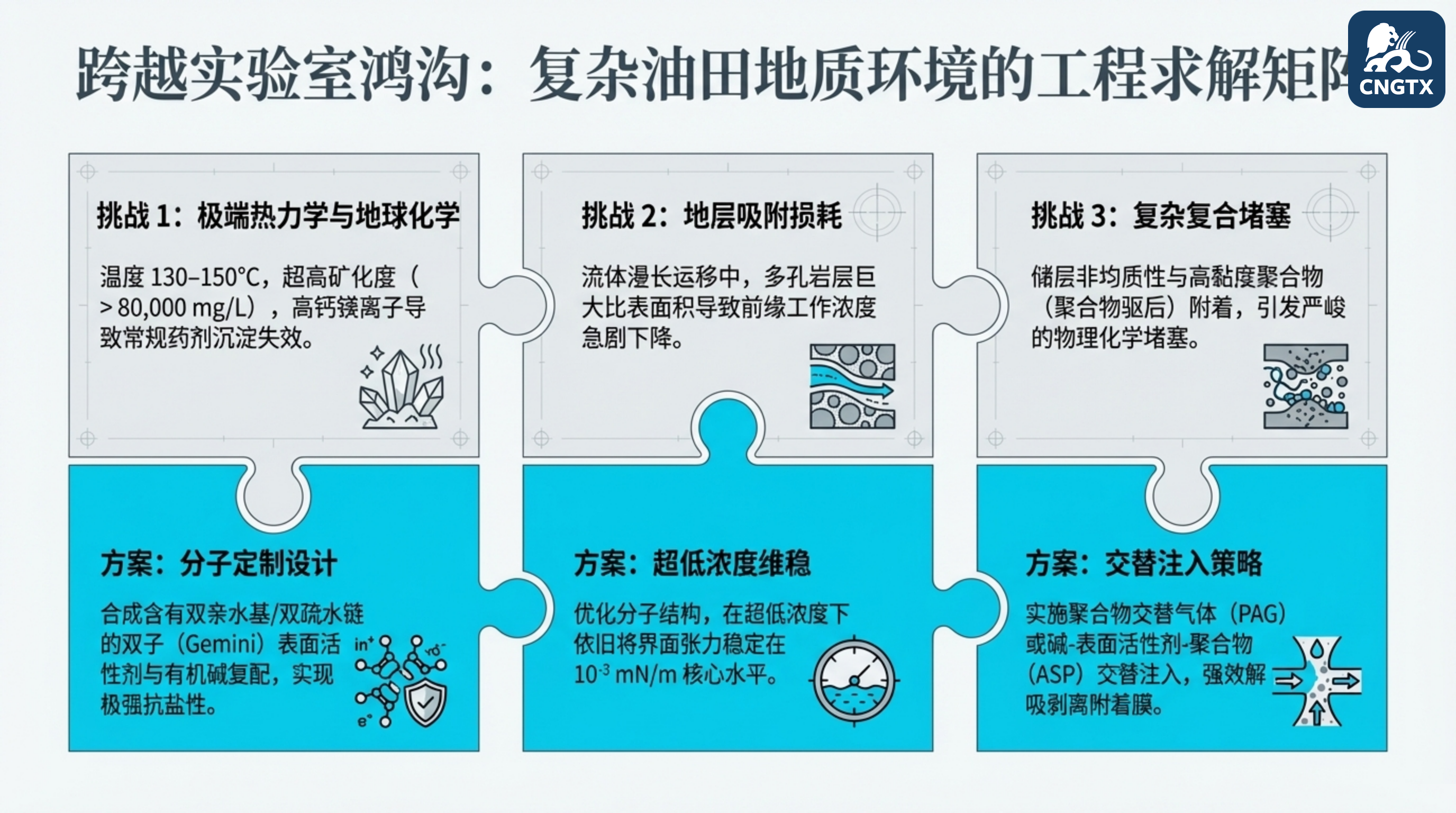
在真实的油田环境中,油田化学(Oilfield Chemistry)工程师们面临着三个难以回避的关键挑战。首先是极端的热力学与地球化学环境:许多深层油藏温度高达 130-150℃,且地层水矿化度极高(如超过 10⁵ mg/L),高浓度的钙、镁等二价离子会导致常规表面活性剂迅速沉淀失效。其次是不可避免的吸附损耗:在流体穿越数千米岩层孔隙的漫长运移中,多孔介质巨大的比表面积会大量吸附表面活性剂分子,导致前缘工作浓度急剧下降,严重削弱其深部调剖与降压效能。最后是储层非均质性与复杂的堵塞问题:特别是对于聚合物驱后的油田,高黏度聚合物层牢牢附着在孔喉壁面上,形成了难以撼动的物理与化学复合堵塞。
In a real oilfield environment, oilfield chemistry engineers face three unavoidable key challenges. First is the extreme thermodynamic and geochemical environment: many deep reservoirs have temperatures up to 130–150°C, and the formation water salinity is extremely high (e.g., exceeding 10⁵ mg/L); high concentrations of divalent ions like calcium and magnesium cause conventional surfactants to rapidly precipitate and fail. Second is the inevitable adsorption loss: during the long migration of fluids through thousands of meters of rock pores, the massive specific surface area of porous media extensively adsorbs surfactant molecules, causing the front-end working concentration to drop sharply, severely weakening its deep profile control and pressure reduction efficacy. Finally, there is reservoir heterogeneity and complex plugging issues: especially for oilfields after polymer flooding, the high-viscosity polymer layer adheres firmly to the pore throat walls, forming an unshakable physical and chemical composite plug.
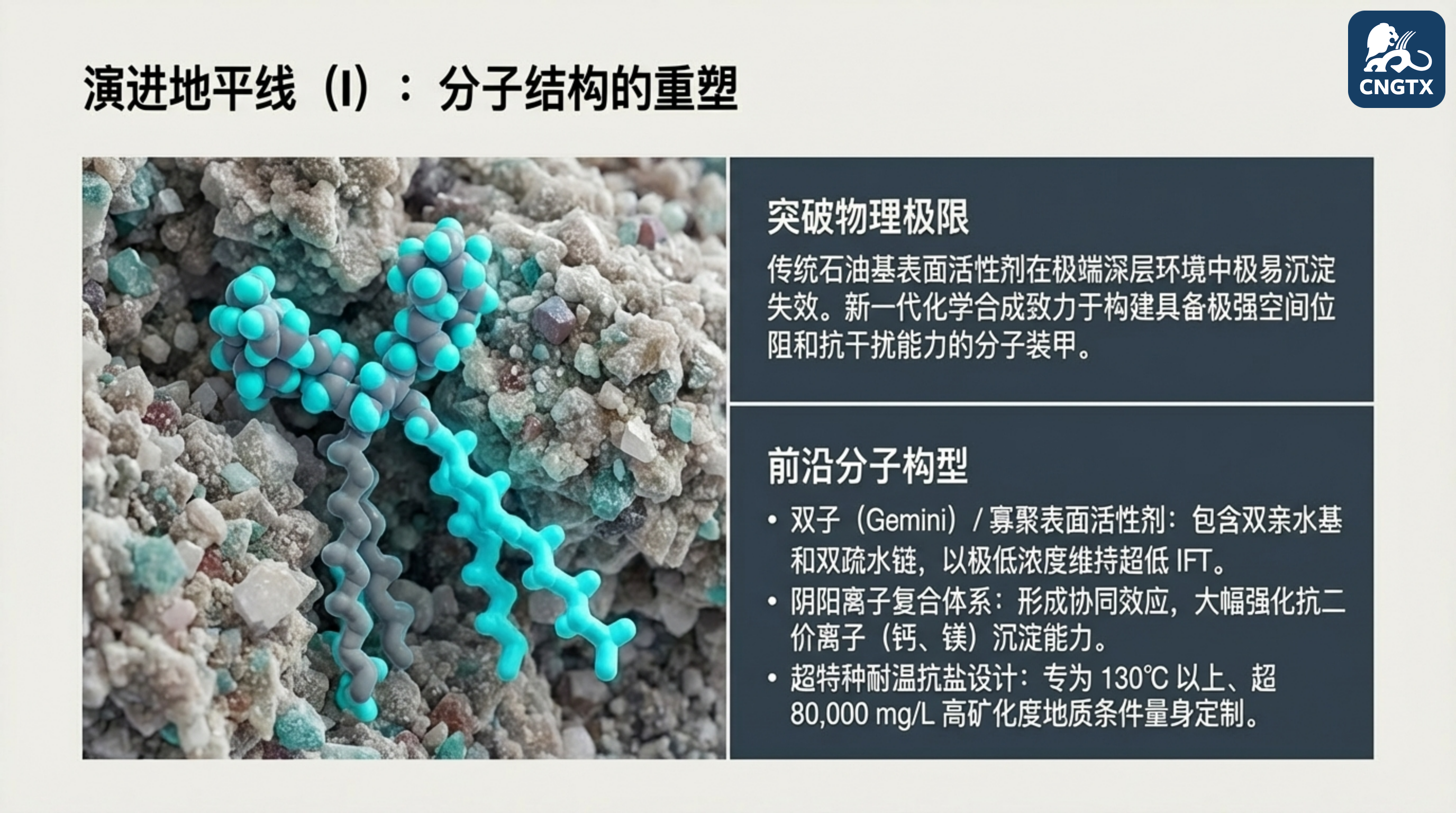
为了应对这些挑战,研究人员和现场工程师开发了一系列高度定制化的策略。解决吸附与耐盐问题的核心在于新型分子的合成。例如,引入含有双亲水基和双疏水链的双子(Gemini)表面活性剂,或将表面活性剂与特定有机碱复配。这种复合体系不仅能将油水界面张力稳定在超低水平(10⁻³ mN/m 甚至更低),还具备极强的抗二价离子干扰能力,从而在低浓度下也能维持高效作业。针对聚合物驱后的严重堵塞,采用聚合物交替气体(PAG)或碱-表面活性剂-聚合物(ASP)交替注入策略,利用表面活性剂极强的解吸剥离能力,成功清除了聚合物吸附膜,实现了压力的显著下降。
To counter these challenges, researchers and field engineers have developed a series of highly customized strategies. The core to solving adsorption and salt tolerance issues lies in the synthesis of novel molecules. For example, introducing Gemini surfactants containing double hydrophilic groups and double hydrophobic chains, or compounding surfactants with specific organic alkalis. This composite system can not only stabilize the oil-water interfacial tension at ultra-low levels (10⁻³ mN/m or even lower) but also possesses extremely strong resistance to divalent ion interference, thus maintaining high-efficiency operations even at low concentrations. For severe blockages after polymer flooding, using Polymer Alternating Gas (PAG) or Alkaline-Surfactant-Polymer (ASP) alternating injection strategies leverages the strong desorption and stripping capabilities of surfactants to successfully clear the polymer adsorption film, achieving a significant drop in pressure.
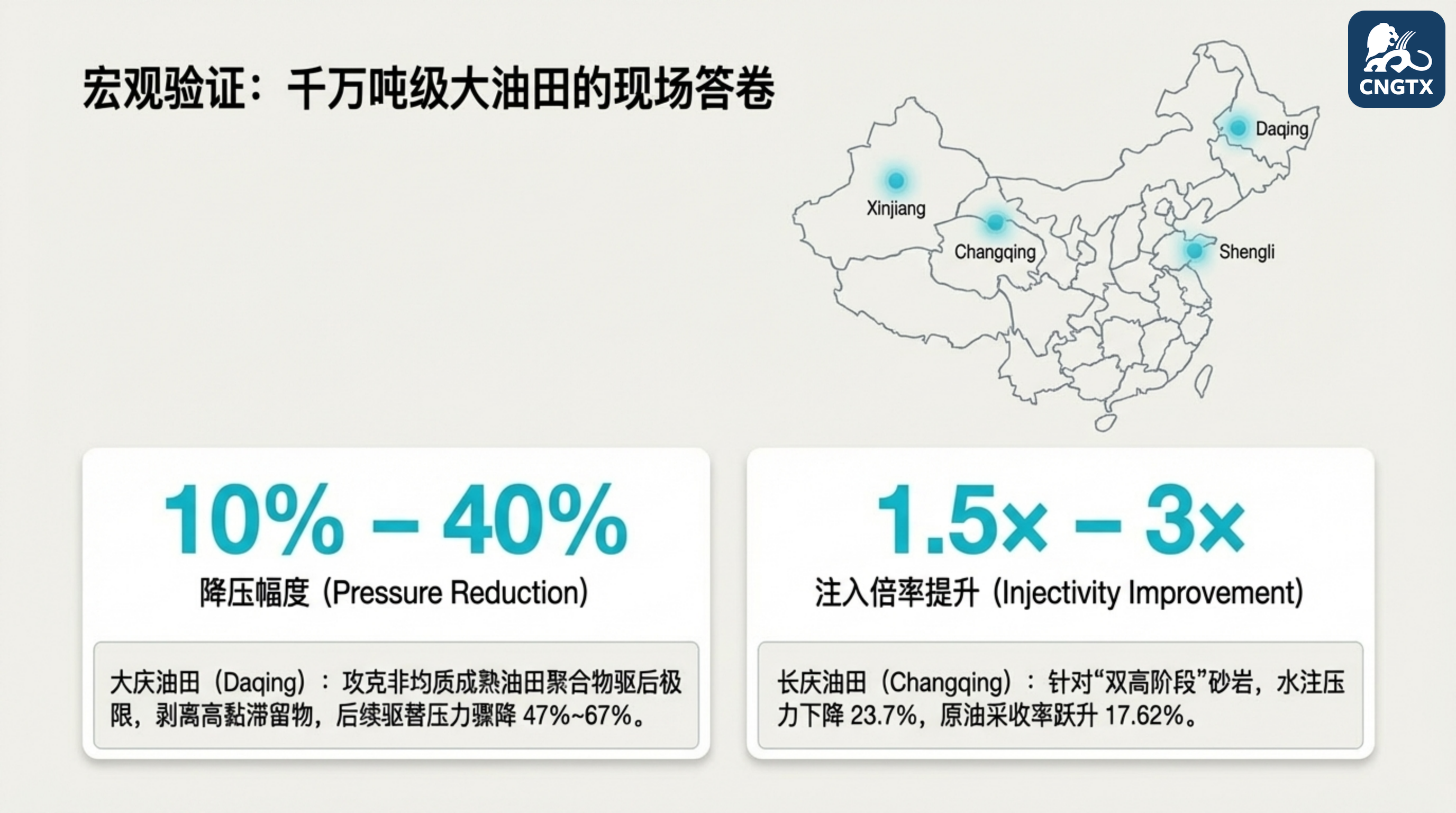
为了直观展示这些先进策略在提高石油采收率中的实际效果,以下对比分析了全球几个代表性复杂油田的现场实施方案与核心数据:
To intuitively demonstrate the practical effects of these advanced strategies in Enhanced Oil Recovery, the following comparative analysis presents the field implementation plans and core data from several representative complex oilfields globally:
| 油田名称与储层类型 Oilfield & Reservoir Type |
现场工程挑战 Field Engineering Challenges |
表面活性剂方案与工艺 Surfactant Solutions & Processes |
降压增注与采收率结果 Pressure Reduction & EOR Results |
|---|---|---|---|
| 中国长庆油田 Changqing Oilfield, China 低渗透/中等孔隙度砂岩 |
注水压力攀升过快,处于中后期"双高阶段",常规水驱采收率低下。 | 采用 0.2% 浓度的十二烷基羟丙基磺基甜菜碱(HPSB)与环烷基石油磺酸盐(NPS)按 8:2 质量比复配的体系,具备优异的抗吸附性。 | 水注压力从 1.52 MPa 降至 1.16 MPa(下降 23.7%);原油采收率从 45.71% 提升至 63.33%(提升 17.62%)。 |
| 中国大庆油田 Daqing Oilfield, China 非均质成熟油田 |
历经多年聚合物驱后,微观波及效率达到极限,深层存在高黏度滞留物堵塞。 | 工业级推广碱-表面活性剂-聚合物(ASP)驱油,利用弱碱替代强碱以控制结垢,交替注入聚合物与表面活性剂-聚合物段塞(PASP)。 | ASP 驱在优质储层中可获得高达 25% 的增量原油采收率;成功剥离聚合物膜,后续驱替压力骤降 47.86%~67.01%。 |
| 美国二叠纪盆地 Permian Basin, USA 非常规页岩/致密油 |
每天产生超 2000 万桶高矿化度采出水,注入困难,压裂过程水流摩擦压力极大。 | 实施 CO₂-泡沫(CO₂-Foam)表面活性剂技术及聚合物涂层支撑剂,控制气体流度,扩大波及体积并极大地降低井口处理压力(WHTP)。 | 注入速率提高 10% 以上;泡沫驱使得实验井组原油产量稳定增加了 30% 至 40%;单井完浆成本节省高达 $325,000。 |
| 美国巴肯地层 Bakken Formation, USA 极高盐度/高温非常规油藏 |
极端的盐度与高温,导致岩石润湿性复杂变化(强烈亲油),原油自然渗吸能力极差。 | 基于人工神经网络(ANN)机器学习优选,采用带有支链醇尾和低环氧乙烷头基的非离子表面活性剂,结合水气交替注入。 | 现场先导试验在 12 个月内实现增产 13,000 桶原油;该项目经济净现值(NPV)高达约 $450,000。 |
从上述详实的数据中我们可以得出结论,表面活性剂降压增注技术并非一套僵化的实验室配方,而是一个高度动态的系统工程框架。通过将化学药剂合成、地质岩性分析、注入段塞设计以及动态流场监测有机结合,工程师们成功地跨越了理论与实地的鸿沟。它不仅解决了常规油田的增产瓶颈,更为开启极难动用的非常规资源(如页岩油)提供了万能钥匙。
From the detailed data above, we can conclude that Surfactant pressure reduction and injection enhancement technology is not a rigid laboratory formulation, but a highly dynamic system engineering framework. By organically integrating chemical agent synthesis, geological lithology analysis, injection slug design, and dynamic flow field monitoring, engineers have successfully bridged the gap between theory and the field. It not only solves the production bottlenecks of conventional oilfields but also provides a master key to unlocking extremely hard-to-tap unconventional resources (such as shale oil).
随着我们对这一技术当前应用深度的了解,我们必须问:这项技术的下一步将走向何方?在最后第四部分中,我们将放眼未来,探讨生物基材料、纳米技术以及人工智能如何彻底改变这一领域,并从心理学的角度阐述为何行业领导者必须紧跟这一颠覆性趋势。
With our understanding of the current application depth of this technology, we must ask: where is the next step for this technology heading? In the final Part 4, we will look to the future, exploring how bio-based materials, nanotechnology, and artificial intelligence will completely revolutionize this field, and from a psychological perspective, elucidate why industry leaders must closely follow this disruptive trend.
第四部分:迈向智能与可持续的未来——纳米技术、生物基材料与全球市场展望
Part 4: Moving Toward an Intelligent and Sustainable Future — Nanotechnology, Bio-Based Materials, and Global Market Outlook
欢迎来到我们四部分系列的最终篇章。在探索了宏观历史、微观流体力学机理以及复杂的现场工程挑战之后,本部分将着眼于表面活性剂降压增注技术(Surfactant pressure reduction and injection enhancement technology)的未来视野。技术从不停留于现状,面对日益严峻的全球气候目标和更深层复杂油藏的开采需求,这项油田化学(Oilfield Chemistry)技术正经历一场向着绿色可持续与人工智能辅助设计的深刻范式演变。
Welcome to the final chapter of our four-part series. After exploring the macro history, micro fluid mechanics mechanisms, and complex field engineering challenges, this part focuses on the future horizon of Surfactant pressure reduction and injection enhancement technology. Technology never rests on its laurels; in the face of increasingly severe global climate goals and the extraction demands of deeper, more complex reservoirs, this oilfield chemistry technology is undergoing a profound paradigm shift toward green sustainability and AI-assisted design.
纳米功能化复合体系的全面崛起
The Comprehensive Rise of Nanofunctionalized Composite Systems
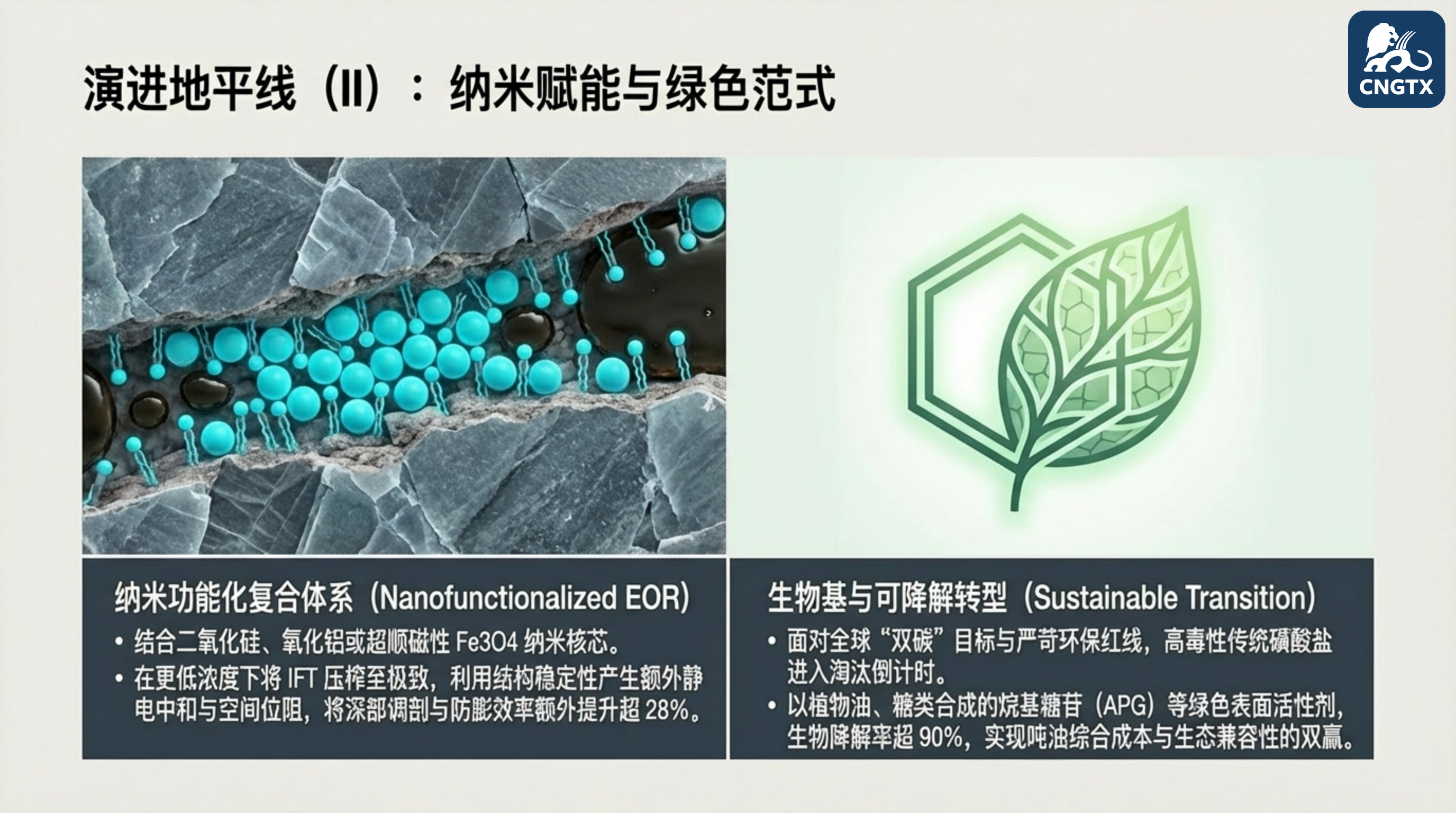
在提高石油采收率(Enhanced Oil Recovery)的未来蓝图中,首要的颠覆性趋势是纳米功能化复合体系(Nanofunctionalized Composite Systems)的全面崛起。传统的表面活性剂在应对极度致密的纳米级孔喉时已接近物理极限,而将表面活性剂与纳米颗粒(如二氧化硅 SiO₂、氧化铝 Al₂O₃ 或具有超顺磁性的 Fe₃O₄ 纳米核芯)结合,开创了全新的解堵维度。纳米微乳液不仅能在更低的浓度下将油水界面张力降至 10⁻⁴ mN/m,其卓越的结构稳定性还能协同产生静电中和与空间位阻效应,将黏土防膨和微裂缝深部调剖的效率额外提升 28% 以上。
In the future blueprint of Enhanced Oil Recovery, the foremost disruptive trend is the comprehensive rise of Nanofunctionalized Composite Systems. Traditional surfactants have approached their physical limits when dealing with extremely tight nanoscale pore throats, whereas combining surfactants with nanoparticles (such as silica SiO₂, alumina Al₂O₃, or superparamagnetic Fe₃O₄ nano-cores) opens an entirely new dimension in blockage removal. Nano-microemulsions can not only lower the oil-water interfacial tension to 10⁻⁴ mN/m at even lower concentrations, but their exceptional structural stability synergistically produces electrostatic neutralization and steric hindrance effects, boosting the efficiency of clay anti-swelling and deep profile control in micro-fractures by an additional 28% or more.
绿色环保与可持续发展的坚决转型
Resolute Transition Toward Green Environmental Protection and Sustainable Development
第二大关键演进方向是向绿色环保与可持续发展(Green Environmental Protection and Sustainable Development)的坚决转型。随着全球各主要经济体实施"双碳"目标并加严废水排放法规,高毒性、难降解的传统石油基磺酸盐正面临淘汰倒计时。行业研发中心正全力竞逐生物基(Bio-based)和可降解表面活性剂(Surfactants)的商业化。以植物油、氨基酸或糖类为原料合成的烷基糖苷(APG)和糖脂类产品,其生物降解率可超过 90%,不仅具备优异的生态兼容性,而且在超低浓度(0.01%–0.1%)下依然保持极高的界面活性,大幅降低了吨油开采的化学与环境综合成本。
The second major evolutionary direction is the resolute transition toward Green Environmental Protection and Sustainable Development. As major global economies implement "dual-carbon" goals and tighten wastewater discharge regulations, highly toxic and hard-to-degrade traditional petroleum-based sulfonates are facing a countdown to obsolescence. Industry R&D centers are fiercely competing for the commercialization of bio-based and biodegradable surfactants. Products like alkyl polyglycosides (APG) and glycolipids, synthesized from vegetable oils, amino acids, or sugars, boast a biodegradation rate exceeding 90%; they not only offer excellent ecological compatibility but also maintain extremely high interfacial activity at ultra-low concentrations (0.01%–0.1%), significantly reducing the comprehensive chemical and environmental cost per ton of oil extracted.
人工智能与大数据算法的深度介入
Deep Intervention of Artificial Intelligence and Big Data Algorithms
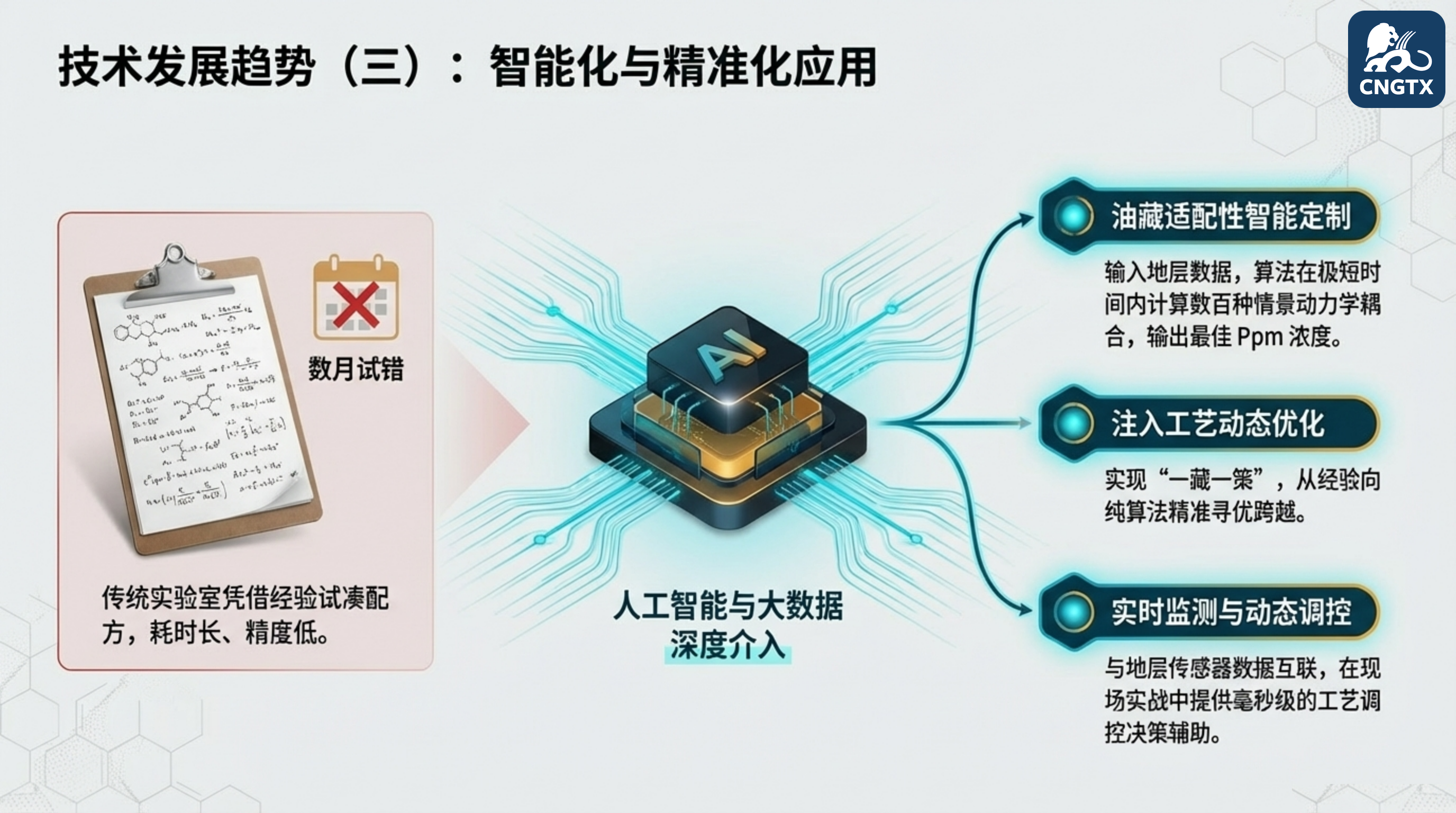
技术的第三个也是最具革命性的未来趋势,是人工智能与大数据算法(Artificial Intelligence and Big Data Algorithms)对复杂油田化学体系的深度介入。在过去,优选最优的注水药剂配方需要耗费数月的实验室试错。如今,基于系统工程(System Engineering)的人工智能框架正在改变这一规则。例如,运用集成了 XGBoost、支持向量机(SVR)等多个底层模型的超学习机(Super Learner ensemble)算法,工程师只需输入目标储层的地层数据,算法就能在极短时间(不到 1 分钟)内计算出超过 500 种注入情景下的化学反应动力学与多相流耦合结果。这种 AI 框架能精准给出使得原油采收率高达 79.49% 的表面活性剂、聚合物和离子的最佳 Ppm 浓度组合,真正实现了从"经验试凑"向"一藏一策智能定制"的历史性跨越。
The third and most revolutionary future trend of the technology is the deep intervention of Artificial Intelligence and Big Data Algorithms into complex oilfield chemical systems. In the past, optimizing the best water injection chemical formulation required months of laboratory trial and error. Today, AI frameworks based on system engineering are rewriting this rule. For instance, by employing a Super Learner ensemble algorithm that integrates multiple base models like XGBoost and Support Vector Regression (SVR), engineers only need to input the target reservoir's formation data, and the algorithm can compute the chemical reaction kinetics and multiphase flow coupling results for over 500 injection scenarios in an extremely short time (under 1 minute). This AI framework precisely outputs the optimal ppm concentration combinations of surfactants, polymers, and ions to achieve crude oil recovery rates as high as 79.49%, truly realizing a historic leap from "empirical trial and error" to "smart customization of one reservoir, one policy."
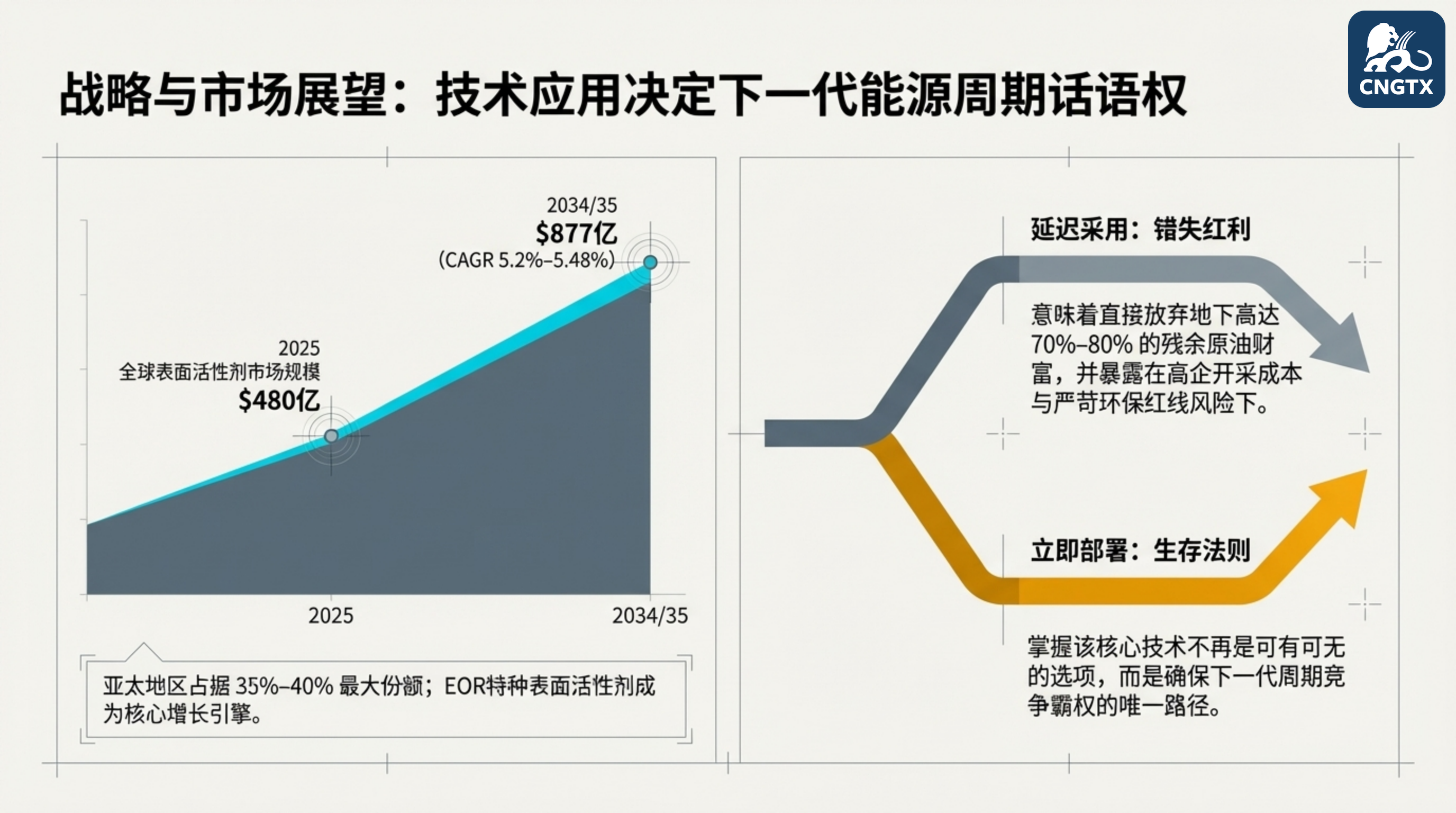
这些颠覆性的技术突破直接映射在全球市场的强劲增长预期中。根据多方权威市场分析报告,全球表面活性剂市场规模估值在 2025 年约为 480 亿至 497 亿美元之间,并预计将以 5.2% 至 5.48% 的复合年增长率(CAGR)稳步攀升,到 2034/2035 年将达到惊人的 770 亿至 877 亿美元规模。在这个庞大的市场矩阵中,亚太地区(尤其是中国和印度)凭借强劲的工业需求占据了超过 35%至40% 的最大份额,而专门用于强化采油(EOR)的特种表面活性剂及纳米材料板块,正成为拉动整个行业技术附加值提升的核心引擎。
These disruptive technological breakthroughs are directly reflected in the strong growth expectations of the global market. According to multiple authoritative market analysis reports, the global surfactant market size is valued at approximately USD 48 billion to USD 49.7 billion in 2025, and is projected to steadily climb at a Compound Annual Growth Rate (CAGR) of 5.2% to 5.48%, reaching an astounding scale of USD 77 billion to USD 87.7 billion by 2034/2035. Within this massive market matrix, the Asia-Pacific region (especially China and India) captures the largest share of over 35% to 40% driven by robust industrial demand, while the specialty surfactants and nanomaterials segment dedicated to Enhanced Oil Recovery (EOR) is becoming the core engine driving the enhancement of the entire industry's technological value-add.
从心理学(Psychology)的视角审视这幅产业全景图,我们可以运用错失恐惧症(FOMO)和损失厌恶(Loss Aversion)的传播学框架向行业利益相关者发出最后的呼吁。数据已经无可辩驳地表明,未能及时拥抱智能化、绿色化增注技术的企业,不仅将失去解锁地下高达 70%-80% 残余原油财富的机会,更将在日益严苛的环保红线和高企的开采成本面前面临资产缩水的风险。对于每一个致力于可持续能源开发的从业者而言,掌握并应用表面活性剂降压增注技术,已不再是一个可有可无的选项,而是确保在下一次能源周期中保持竞争霸权的生存法则。
Examining this industrial panorama from a psychology perspective, we can employ the communication frameworks of Fear Of Missing Out (FOMO) and Loss Aversion to make a final appeal to industry stakeholders. The data has irrefutably shown that enterprises failing to promptly embrace intelligent and green injection enhancement technologies will not only lose the opportunity to unlock the wealth of up to 70%–80% residual crude oil underground, but will also face the risk of asset depreciation in the face of increasingly strict environmental red lines and soaring extraction costs. For every practitioner dedicated to sustainable energy development, mastering and applying surfactant pressure reduction and injection enhancement technology is no longer an optional choice, but a survival rule to ensure competitive hegemony in the next energy cycle.
至此,我们的《表面活性剂降压增注技术与提高石油采收率》四部曲圆满结束。从回溯上世纪最初的界面张力发现,到凝视纳米孔隙内液滴的破碎与重塑;从见证长庆与大庆油田泥泞现场的百炼成钢,到展望 AI 算法在毫秒间决断油藏未来的宏大图景,我们试图用跨学科的严谨与生动,为您还原这项伟大技术的全貌。感谢您的全程参与,期待这些知识的火花能为您在广袤油田上的探索照亮前路。
With this, our four-part series on "Surfactant Pressure Reduction and Injection Enhancement Technology and Enhanced Oil Recovery" comes to a successful conclusion. From looking back at the initial discoveries of interfacial tension in the last century to gazing at the fragmentation and reshaping of droplets within nano-pores; from witnessing the rigorous tempering at the muddy sites of the Changqing and Daqing oilfields to envisioning the grand picture of AI algorithms deciding the future of reservoirs in milliseconds, we have sought to restore the full picture of this great technology for you with multidisciplinary rigor and vividness. Thank you for your engagement throughout, and we hope these sparks of knowledge will illuminate the path forward for your exploration across vast oilfields.